ProcessWire – The dream CMS

ProcessWire is like that small, charming restaurant on the corner – not world-famous, but world-class. And it beats any major fast-food chain in quality.

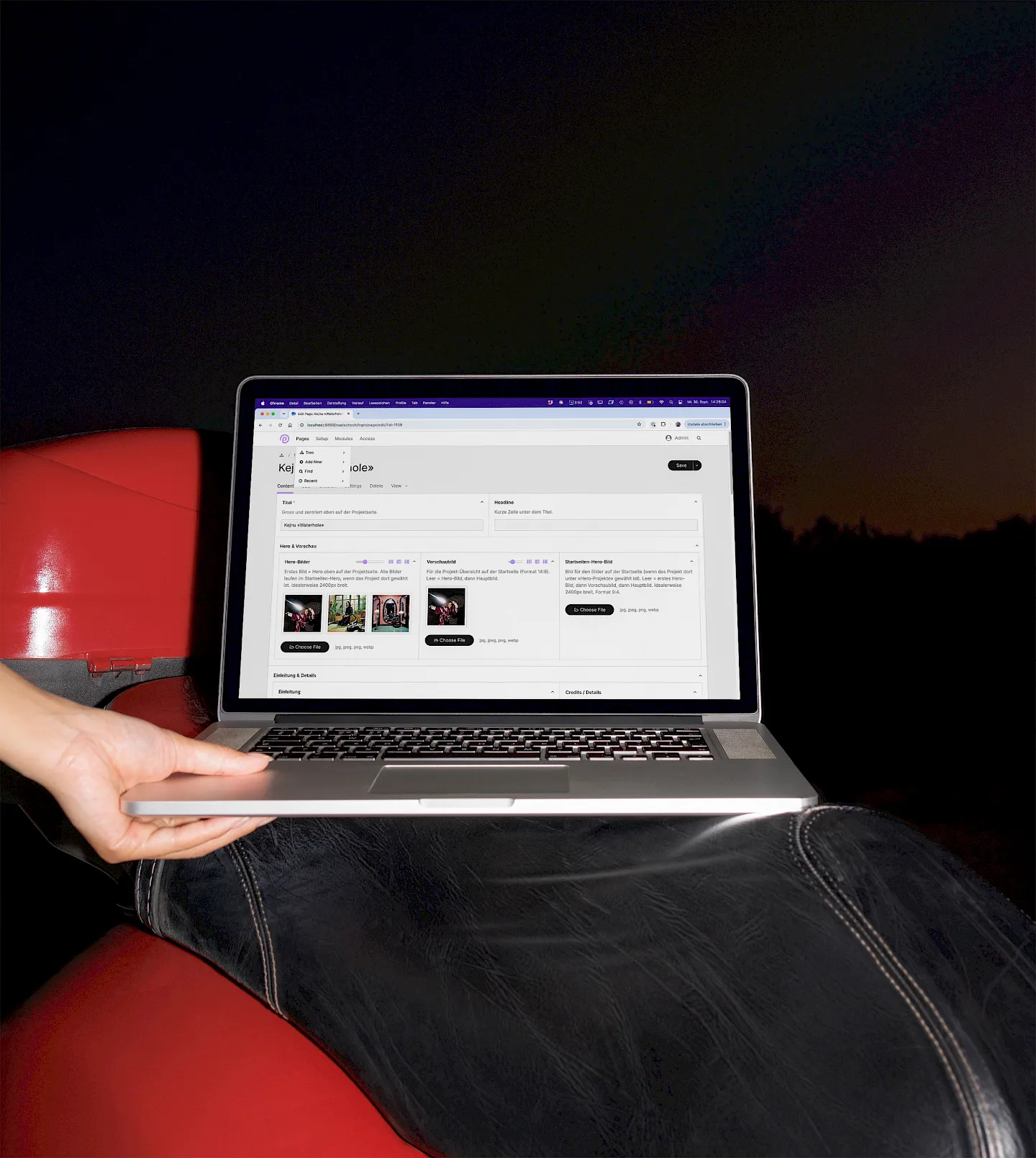
A hand holding a laptop with a ProcessWire backend on a red leather armchair in a dimly lit room
The Processwire backend is lightweight, well-organized, intuitive, and self-explanatory

What is ProcessWire?

ProcessWire is a free, open-source CMS developed by U.S. developer Ryan Cramer. Everything is a page; every page has a template; every template has fields: text, images, data, dropdowns, checkboxes, documents, and links to other pages. This creates a page tree that feels like a well-organized folder structure.

ProcessWire doesn’t come with a pre-designed look or a jumble of plugins. It provides a clean foundation on which I can build exactly what your website needs – and nothing that slows it down.

ProcessWire or WordPress?

WordPress started out as blogging software and thrives on themes and plugins: You buy a theme, add a page builder and twelve plugins – three of which conflict with each other, and one hasn’t been maintained since 2019. After a year, no one dares to click “Update” anymore.

That’s exactly where most security vulnerabilities lie: 97 percent of the vulnerabilities newly reported in the WordPress ecosystem in 2023 affected plugins, while only 0.2 percent affected the core. I regularly come across hacked WordPress sites, and every now and then I have to rescue entire servers because backdoors and malicious links were injected through an outdated installation. ProcessWire has most of what you need built right into the core; updates are rare and take just minutes. You can find a detailed comparison on the ProcessWire website itself.

A laptop displays a screenshot of a website showing a stage photo and a microphone against a gray background
Website for El Tony Mate

What's in it for you?

The backend shows only what you’re actually managing: logically grouped, with hints on where everything belongs. If you prefer a streamlined approach, you get clear, fixed fields; if you want freedom, you get configurable, complex building blocks for text, images, videos, tables, or accordions. A new landing page, a new product, a new post – all completely autonomous.

Because I don’t work with off-the-shelf themes, your website won’t look like ten thousand others. It grows with you: new languages, a shop, a members-only area, new interfaces. Instead of rebuilding everything every three years, we build on what’s already there. Permissions can be assigned down to the individual field level: Employee A can write news posts but can’t change prices; Employee B can create entire landing pages and view new contact requests.

Modules and AI

Modules handle what the core can’t: forms, multilingual support, two-factor authentication, firewalls, and cookie banners. A few well-maintained ones instead of a hundred half-baked ones – most of them free. If nothing fits the bill, I write modules myself: the interface to the ERP system, a custom data importer, or AI tools that autonomously maintain metadata.

Editors like Claude Code or Cursor work wonderfully with ProcessWire and handle the grunt work. This frees up time for the important things: concept, front-end and back-end UX/UI, design and brand consistency, SEO, and accessibility.

Close-up of a module overview with an MCP server map on a bright screen
Laptop displays the EHC Kloten website featuring players and the slogan “United in color since 1934”
CMS website for EHC Kloten

Frequently Asked Questions About ProcessWire

What is ProcessWire?

A free, open-source CMS (content management system) based on PHP. Content is organized into pages, templates, and fields; the layout is flexible and not tied to a specific theme.

Is ProcessWire better than WordPress?

For custom websites, yes: Custom fields and templates are built right into the core rather than added via plugins. That means less third-party code, faster pages, and fewer vulnerabilities. For an off-the-shelf blog, WordPress is quicker to set up and doesn’t require a developer.

Is ProcessWire secure?

Security vulnerabilities in the core of ProcessWire are rare and are quickly patched. Because third-party plugins are rarely needed, there is little external code that could contain vulnerabilities. In addition, the system offers permissions down to the individual field level and two-factor authentication.

How much does ProcessWire cost?

ProcessWire itself is free – no subscription and no license fees. Costs are incurred for the website's concept, design, and development, as well as for hosting. Updates are rarely necessary and can be completed in just a few minutes.

Can you update the content yourself?

Yes. The backend displays only the fields you actually need, with instructions on where each one goes. You create new pages, posts, or products yourself. You build complex pages using pre-built, precisely configurable building blocks.

Who builds websites with ProcessWire in Switzerland?

I’m Nuél Schoch from Zurich: I’ve been building websites since 2005, and for years now I’ve been using only ProcessWire, for clients throughout Switzerland and neighboring countries. Three of my websites have been named “Site of the Week” by ProcessWire Weekly. My biggest clients include El Tony Mate, Puerto Mate, and EHC Kloten.

ProcessWire in Switzerland

I’ve been building websites since 2005, based in Zurich for clients throughout Switzerland and neighboring countries, and for years now I’ve been using only ProcessWire. With every new project, I’m amazed all over again by just how powerful this system is.

ProcessWire Weekly has named three of my websites “Site of the Week”: El Tony Mate, TUNA production, and Seline Fülscher.

Want more details? Tell me about your project.

Send me a message

Projects